Newmark Commercial Real Estate
Logistics Real Estate in South Florida: What It Is, the Different Types, and Why It Matters for Your Business
July 14, 2026
Newmark Commercial Real Estate
If a product reaches a doorstep in Miami, Fort Lauderdale, or West Palm Beach within a day of being ordered, a piece of logistics real estate made it happen. Behind nearly every supply chain sits a building — a warehouse, a distribution center, a cold-storage facility — quietly doing the work of keeping goods moving. As South Florida cements its role as one of the most important trade gateways in the Americas, understanding logistics real estate has become essential for any business that stores, ships, or sells physical products.
At Newmark Commercial, we’ve spent more than 20 years helping South Florida businesses, owners, and investors navigate the commercial real estate market. This guide breaks down what logistics real estate is, the different types you’ll encounter, and what makes our region one of the country’s most competitive industrial markets.
Logistics real estate refers to commercial buildings designed for storing, handling, and distributing goods. It’s a category of industrial property that includes warehouses, distribution centers, and fulfillment centers — the physical infrastructure that supply chains run on. Businesses of every size, from a local retailer to a global manufacturer, depend on logistics space to operate efficiently.
Unlike office or retail space, logistics property is valued less for its appearance and more for its function: ceiling height, loading-dock access, floor strength, truck-court depth, power capacity, and — above all — location relative to highways, ports, airports, and customers.
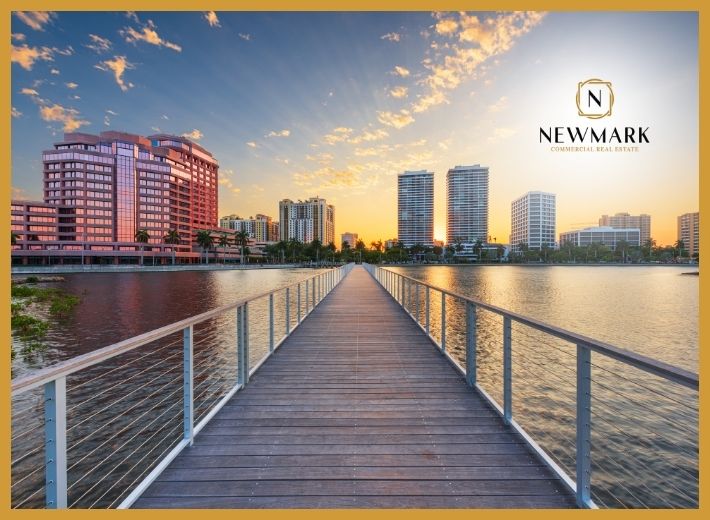
Few regions in the country combine as many logistics advantages as South Florida. The tri-county market — Miami-Dade, Broward, and Palm Beach — sits at the crossroads of domestic and international trade.
That mix of trade, transportation, and population density is exactly why logistics space here is in such high demand — and why site selection requires local expertise.
“Logistics real estate” is an umbrella term. Each property type serves a different role in the supply chain, and choosing the right one depends entirely on what your business actually does.
Warehouses — Large buildings used for storing goods (finished products, raw materials, or inventory). They’re typically located near major transportation hubs and form the backbone of most distribution networks.
Distribution Centers — More active than a basic warehouse, distribution centers are built for sorting, packaging, and shipping. They’re equipped with loading docks, conveyor systems, and materials-handling equipment to move goods out to retailers and consumers quickly.
Fulfillment Centers — Smaller, tech-forward facilities focused on picking, packing, and shipping individual orders — the engine behind e-commerce. They’re usually positioned near major metro areas so online orders reach customers fast.
Cross-Docking Facilities — Designed for speed rather than storage, cross-dock facilities transfer goods directly from one truck to another with minimal time in between — ideal for keeping freight moving across the region and the country.
Cold-Storage Facilities — Temperature-controlled warehouses for goods that require refrigeration: food, produce, pharmaceuticals, and other sensitive products. Given South Florida’s role in perishable imports and its dense population, cold storage is one of the most sought-after — and undersupplied — categories in the market.
Micro-Fulfillment Centers — Compact facilities placed inside or near dense urban areas to support same-day and next-day delivery. As shoppers expect faster delivery windows, these last-mile nodes are becoming increasingly valuable across South Florida’s cities.
The right building in the wrong location can quietly drain a business through higher transportation costs and slower delivery times. When we help clients evaluate logistics property, these are the factors that matter most:
| Proximity to transport hubs | How close is the site to PortMiami, Port Everglades, Miami International Airport, I-95, and the Turnpike? Minutes saved here compound over thousands of shipments. |
| Proximity to your market | If you serve local consumers, an infill site near population centers beats a cheaper one far from your customers. |
| Labor availability | Logistics operations need staff. A strong local labor pool keeps facilities running and hiring manageable. |
| Zoning & permitting | Confirm the site is zoned for your use and that truck traffic, hours, and noise are permitted — early due diligence prevents costly surprises. |
| Building specs | Clear height, dock count, truck-court depth, floor load, and power capacity determine whether a building fits modern — and automated — operations. |
South Florida’s strengths come with real constraints. Demand consistently outpaces supply, which keeps rents and land prices high. Available industrial land is limited, especially in prime infill locations, and construction costs make new development expensive. Skilled labor can be difficult to secure. None of these are reasons to avoid the market — but they are reasons to enter it with a knowledgeable local partner who can help you weigh trade-offs before you commit.
“In South Florida, logistics real estate isn’t just about square footage — it’s about minutes. The right location near a port, the airport, or a major highway can transform how efficiently a business runs. Our job is to help clients find the building that actually fits their operation, not just the one that’s available.”
— The Newmark Commercial Team
What’s the difference between a warehouse and a distribution center?
A warehouse primarily stores goods, while a distribution center is built for active movement — sorting, packing, and shipping products out quickly. Many businesses need a blend of both.
Is South Florida a good place for a logistics business?
For most product-based businesses, yes. The combination of major seaports, a top international airport, strong highway access, and a large local population makes the region one of the most strategic logistics markets in the country — though space is competitive.
Should I lease or buy logistics space?
It depends on your capital, growth plans, and how long you intend to stay in a location. Leasing offers flexibility; ownership can build long-term equity and control. We help clients model both before deciding.
How far in advance should I start looking?
Because quality industrial space in South Florida moves fast, it’s wise to begin the search several months ahead of when you need to occupy. Early planning gives you room to negotiate rather than settle.

Whether you’re searching for a warehouse, scaling into a distribution center, or weighing an investment in South Florida industrial property, the right guidance makes all the difference. With more than 20 years of experience in the local commercial market, the team at Newmark Commercial is ready to help you find a space that fits your operation and your goals.
➤ Contact Newmark Commercial today to start the conversation.
📞 Call us: 561-702-8187
🌐 Visit: newmarkcommercial.com
Let us find the right property for you.